
Three Ways that High Water Levels Impact our Monitoring Work
Mikela Dean
Climate change leads to more intense and unpredictable weather. This, in combination with other factors, including impermeable surfaces like concrete and asphalt and a loss of vegetation, means that rivers like the Clinton are experiencing high water levels more frequently.
Lydia Nicholas
High water levels can impact our work at CRWC in a variety of ways, such as our ability to complete monitoring work. This spring, we were forced to cancel our annual Adopt-A-Stream event due to unsafe conditions in the river thanks to high water levels. Specifically, these conditions threatened our data integrity, the safety of our volunteers, and the logistics of the event.
Through Adopt-A-Stream, we monitor the health of our waterways at locations throughout the watershed on the first Saturdays in May and October. These dates have formally been in place since the 2009 Michigan Clean Water Corps (MiCorps) Quality Assurance Project Plan (QAPP). This requirement supports our data integrity as we look at long-term trends.
It’s also important to note that in times of high flows, macroinvertebrates are disturbed from their normal habitats and flushed downstream. During Adopt-A-Stream, our staff and volunteers search for macroinvertebrates, as their presence and the diversity of their communities help to determine water quality. So, in the case of high water levels, our macroinvertebrate data would not be comparable to data collected during average/low flow events.
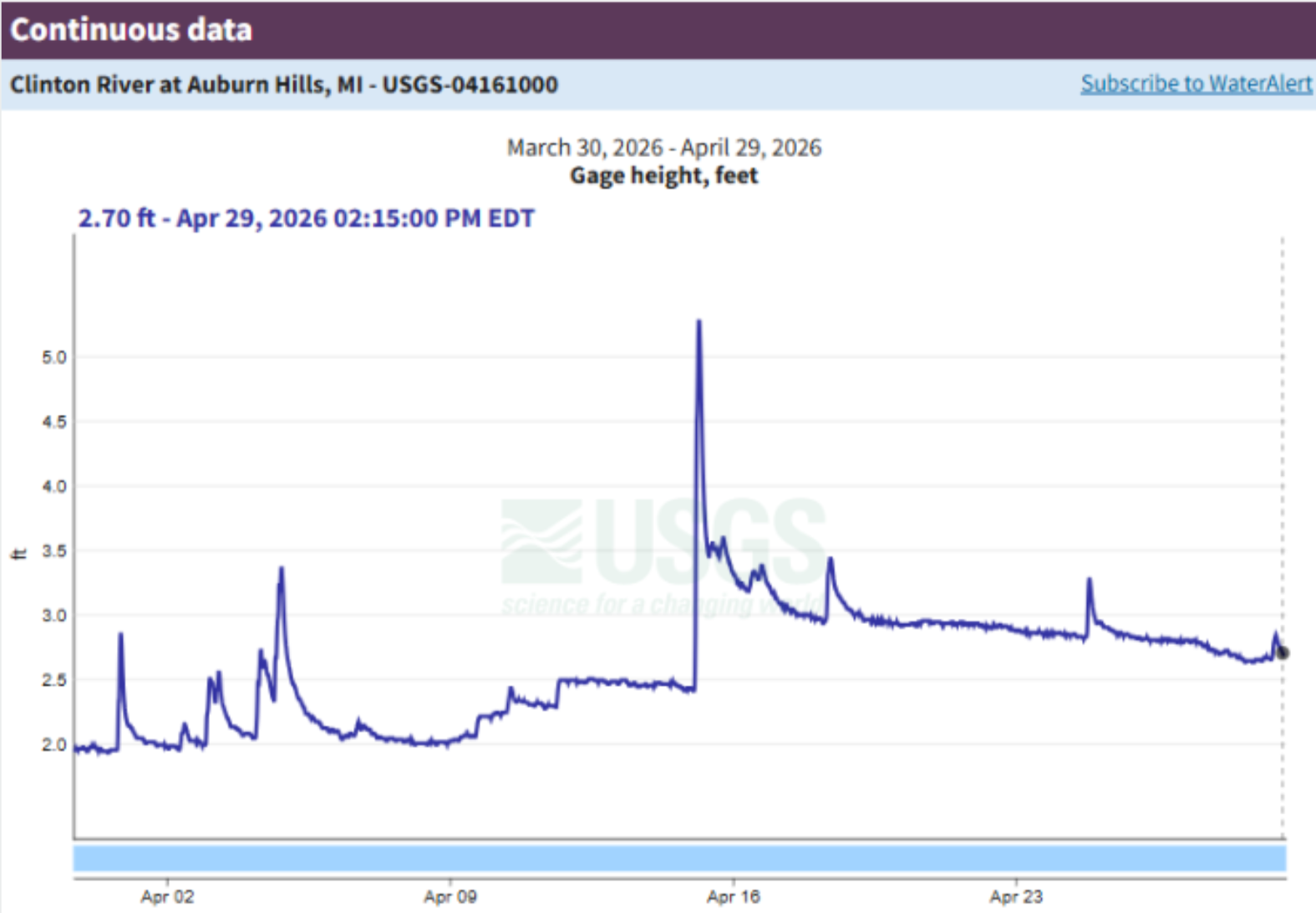
Data from the USGS Stream Gauge in the Clinton River in Auburn Hills, March 30 – April 29, 2026. Water levels were elevated by about 1 foot following a rain event on April 14. As a result, water was flowing above the step at Riverside Park and over Yates Dam.
Volunteer safety is also very important. In high flows, people wading are more at risk of tripping and falling in the water due to the lack of visibility and the force of the water. Adopt-A-Stream has a wide variety of volunteers, ranging from children to retirees, so we do everything within our power to ensure our volunteers are not putting themselves in situations that may be riskier than normal. In addition, the QAPP requires that volunteers wait at least three days after heavy precipitation before sampling.
In terms of logistics, over 100 volunteers monitor 35 to 50 sites during our Adopt-A-Stream events. In addition, several of our volunteer team leaders coordinate multiple sites and teams. Canceling or rescheduling a monitoring event due to high water levels can be a challenge considering the number of people, sites, and equipment involved.
As the climate changes, we are looking at how we can adjust in response. Our team is working with the Huron River Watershed Council and MiCorps to explore how we can improve support at monitoring sites and/or shift dates without compromising data integrity.
If you’re interested in volunteering for any of our monitoring programs, Stonefly Search, Adopt-A-Stream, or Lake Erie Volunteer Science Network (LEVSN), please visit our website.